The Art of Calibrating Your Most Senior Directs
- Priya Venkatesan
- Apr 18
- 2 min read


The higher you rise in your career, the harder it becomes to give feedback with candour to your directs.
Not because you lack the words. But because the person sitting across from you has "earned" something — tenure, respect, a track record.
At senior levels, you assume competence means self-awareness.
And that changes how you speak to them.
You soften. You hint. You hope they read between the lines.
They don't.
The performance gap widens. The conversation gets harder. And eventually, what could have been a calibration becomes a crisis.
Calibration at this level isn't about fixing someone. It's about caring enough to tell the truth.
Senior leaders don't need softer feedback.
They need clearer feedback — delivered with respect, but without dilution.
The question isn't: How do I say this without upsetting them?
The question is: What does this person need to hear to operate at their full capacity?
Before you walk into a calibration conversation, diagnose where you stand on two dimensions: the strength of your relationship, and their willingness to change.
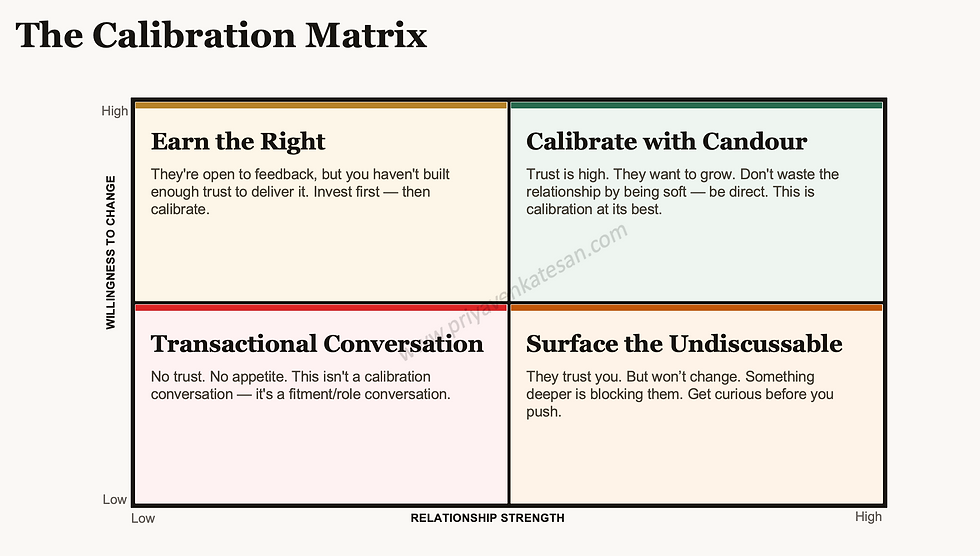
When you're ready to have the conversation, structure it around five pillars:
1. Acknowledge the baseline: "You've built real credibility here. That's not in question."
2. Name the specific gap: "What I'm not seeing is [Behaviour X]. And at this level, that's what separates good from exceptional."
3. Invite ownership: "What's your read on this? And what would it take to close the gap?"
Offer support: "How may I help?"
Cadence: " Lets define MoS & circle on a quarterly basis to measure progress."
No sandwiching. No softening. Just clarity, delivered with respect.
Reflections for a leader having senior directs:
Who on your team have you been hinting at instead of calibrating?
Which quadrant is that conversation in?
What's the cost of waiting another quarter?
This is Part 2 of my Leading Leaders series. Stay tuned for the next.
Here you can find Part 1.


